



easteregg
Dark background with blue accents with light reflectionsDark background with blue accents with light reflectionsDark background with blue accents with light reflections

PPP for SaaS Startups
Using Purchasing Power Parity for SaaS startups

PPP for SaaS Startups - Using Purchasing Power Parity for SaaS startupsPPP for SaaS Startups - Using Purchasing Power Parity for SaaS startups

Being an entrepreneur, or maybe even a shining founder of a new startup, you are likely on the lookout for fresh methods that could expand your startup's reach and, if lucky enough, even fuel growth. One game-changing approach - that is not related to advertising or any other paid methods - is becoming more and more popular each year is implementing Purchasing Power Parity (PPP) pricing. By using this economic concept, SaaS startups can unlock new untapped markets, make their customer base wider, and promote inclusivity on a global scale. But what exactly is "Purchasing Power Parity"?
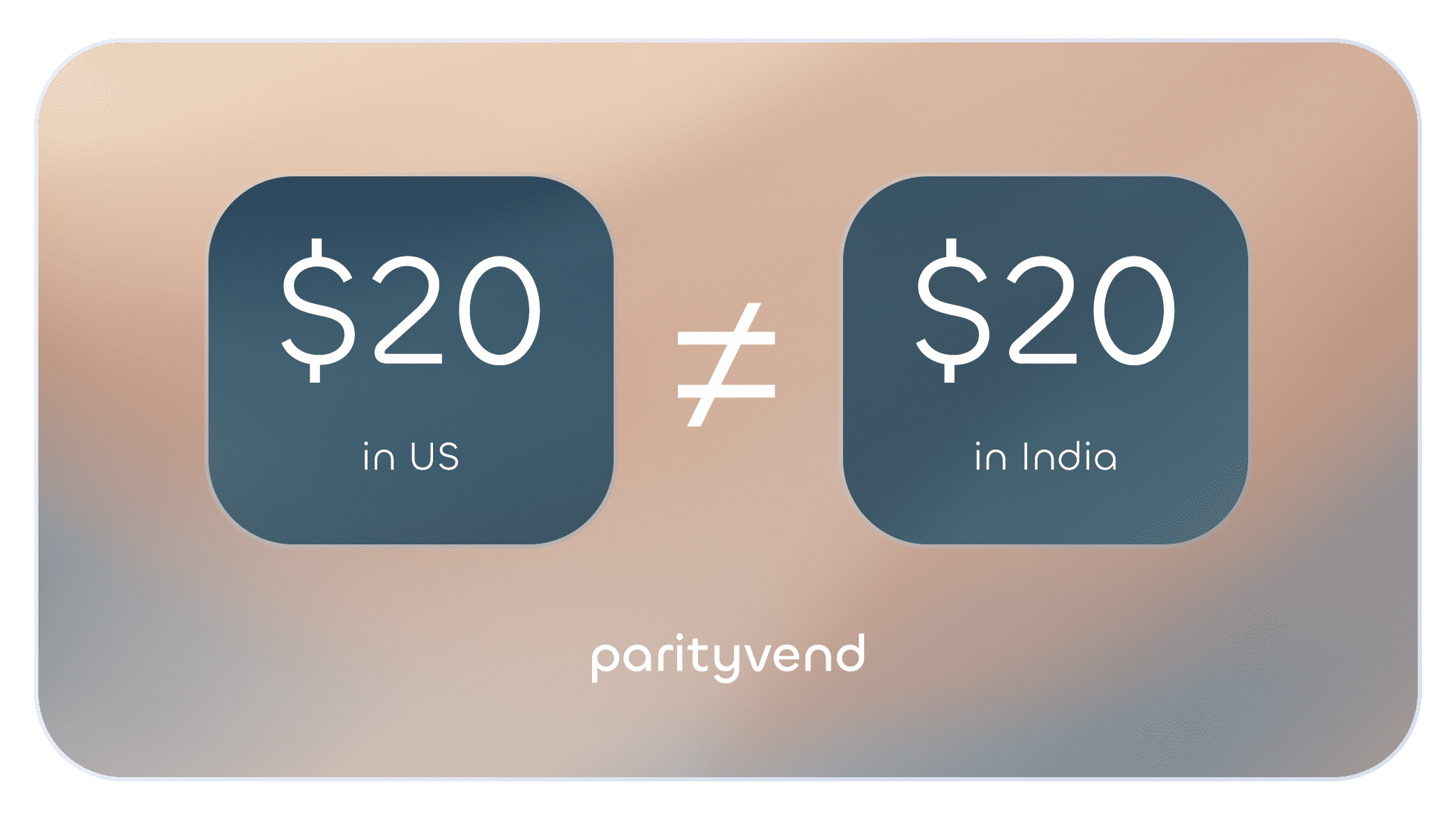
Having the same amount of money in two countries doesn't always mean you can buy the same amount of goods.
Having the same amount of money in two countries doesn't always mean you can buy the same amount of goods

The Scoop on Purchasing Power Parity

Simply put, the Purchasing Power Parity (PPP) theory says that money doesn't have the same value in every country. This means that the exact same amount of money can buy much more or less - depending on where you are. The PPP value tells us how much things cost in one country compared to another, considering how rich the countries are and how much people can buy with their money.

This may sound strange at first - so let's take an example of how PPP might look for your startup. A SaaS product priced at $10 per month might be a reasonable ask for customers in the US. Still, it could be too expensive for users in lower-income countries like Brazil, India, Argentina, or Pakistan. With PPP, SaaS startups can adapt their pricing to each country's buying power, making their services more accessible and affordable to a wider range of customers. 

So, instead of having the same price of $10 everywhere, with PPP, you would instead reduce it for countries with lower purchasing power. An example PPP pricing for this abstract SaaS might look like this:
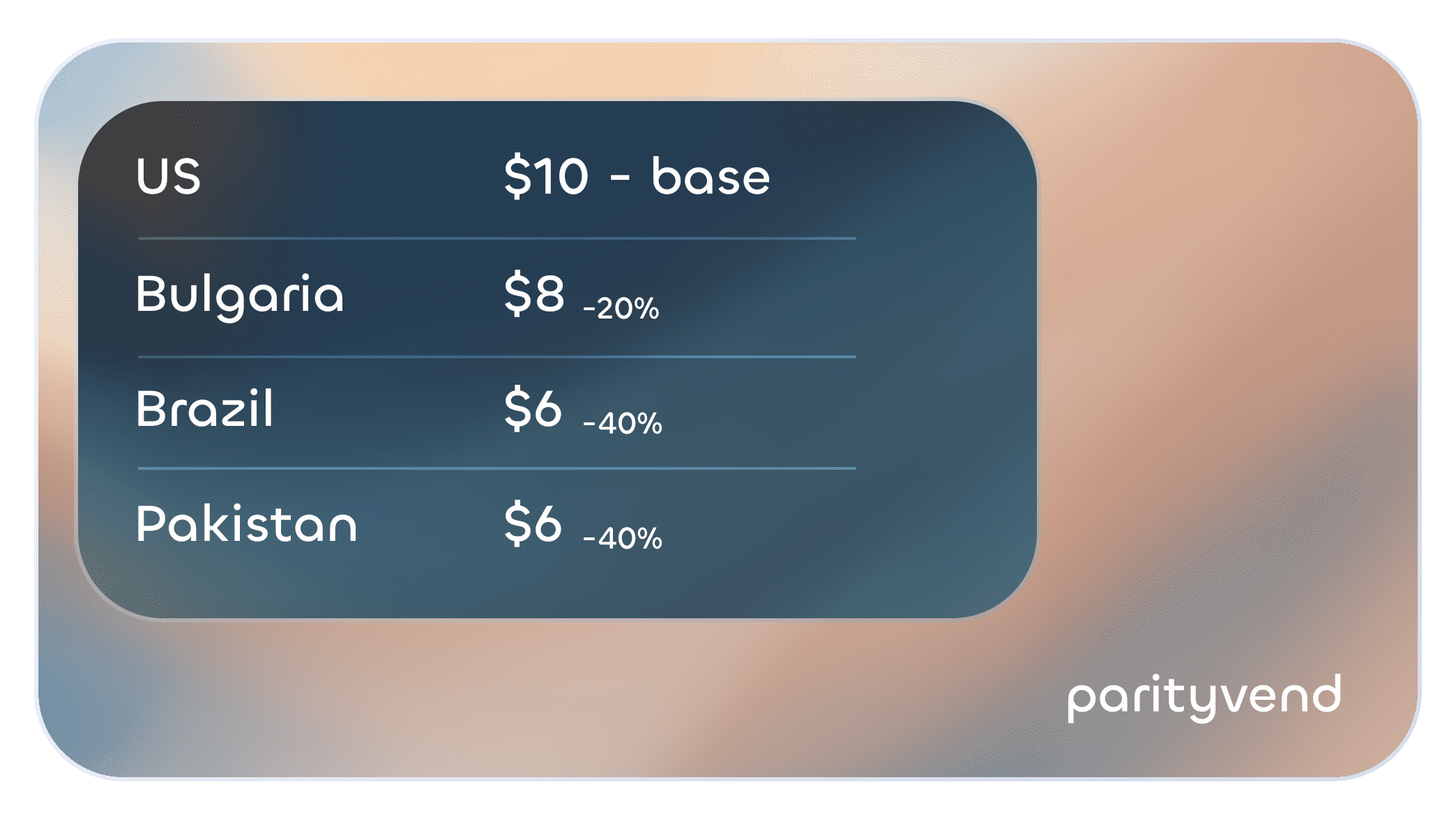
An example of how you can implement purchasing power parity in your SaaS

Why Implement PPP for SaaS Startups?

Adopting a PPP pricing strategy can bring numerous advantages to SaaS startups. It can help you navigate the global market's complex sides and explore new, previously unavailable opportunities.

Expanded Market Reach

One of PPP's biggest advantages is the ability to break into new markets and attract customers from regions where standard pricing would have been inappropriate. Unfortunately, not all countries have the same level of salaries as in the US. By offering location-based discounts, your SaaS startup can put its products within reach of a much larger audience - which will open up fresh revenue streams and increase your global growth.

Boosted Sales and Revenue

While this may sound strange, offering discounts can increase your overall revenue. By reducing your prices in lower-income regions, you make your product more affordable and open the door to a larger customer base - who would not have been able to buy your product before due to its unsuitable price. This strategy lets you gain more sales in emerging economies and expand into previously untapped revenue sources.

Inclusivity and Accessibility

SaaS products - including yours - have the potential to empower people and businesses all around the world. However, varying economic situations can often create obstacles to accessing your products. By integrating PPP pricing, you can show your dedication to inclusivity and accessibility. This approach helps make your prices fair to everyone and ensures that your offerings are affordable for customers across different economic backgrounds. Additionally, this commitment to inclusivity can also foster customer loyalty.

Building Brand Loyalty

Customers greatly appreciate it when startups acknowledge and respect their economic realities. By offering fair and accessible pricing through PPP, your SaaS startup can foster brand loyalty and transform their customers into "brand fans". This positive sentiment can lead to increased word-of-mouth marketing and a stronger brand presence across different markets.

Competitive Advantage

By offering location-based pricing, you can also differentiate your offers and position yourself as a more attractive and accessible option compared to competitors who do not take advantage of PPP. Not only will your products be more affordable than others, but by adopting PPP, you will also demonstrate your commitment to global inclusivity, showing your customers that you do care about them (while your competitors don't - shame on them).

Putting PPP Into Practice

While the benefits of PPP pricing are intriguing, actually implementing it requires a lot of planning and consideration. Here are some strategies and factors to keep in mind:

  1. Research: The foundation of any successful PPP pricing strategy is built on research and data collection. You will need to gather information on buying power, cost of living, and economic indicators of each country - and there are at least 190 countries in the world. You will need all this data to perform the pricing adjustments and ensure discounts are appropriately aligned with local economic conditions.
  2. Pricing Tiers: Based on the collected data, you will then be able to establish pricing tiers and segment your potential customer base accordingly. This can involve creating multiple pricing plans, each tailored to specific regions or income levels, as well as deciding on the discount sizes.
  3. Integration: Integrating PPP can be a complex process, especially when dealing with multiple pricing tiers or products, frequent currency changes, and the need to prevent potential abuse. To streamline this process, businesses can use automation solutions and APIs that dynamically adjust pricing based on the customer's location and buying power.
  4. Addressing Potential Abuse: As mentioned earlier, another concern with PPP pricing is the risk of abuse, such as customers using VPNs or proxy servers to fabricate their location and gain access to lower pricing tiers. For example, someone from the UK might try to use an Indian VPN to get access to discounts on your SaaS products - which will surely harm the integrity of your business operations. To reduce this risk, SaaS startups can implement anti-abuse measures, such as VPN detection or IP-block lists.
  5. Continuous Monitoring: Economic conditions and buying power can change over time, so it's important for you to continuously monitor and optimize your PPP pricing strategy. This can include periodical adjustments to purchasing power data, and refinement of anti-abuse measures - all to ensure the long-term effectiveness and fairness of the pricing model.

So, do we need PPP?

By using Purchasing Power Parity pricing, SaaS startups can unlock a world of opportunities and position themselves for sustainable growth in the global market. Still, while implementing PPP by yourself is possible, it can be a time-suck and a headache, especially when dealing with multiple pricing tiers, currency fluctuations, and concerns around potential abuse. With careful planning, data-driven decision-making, and the right tools and strategies in place, startups can navigate the complexities of international pricing. That's where ParityVend comes in – an innovative SaaS platform that automates the entire PPP pricing process for your digital products.

ParityVend: Streamlining PPP Implementation

ParityVend is a game-changing solution that simplifies the implementation of PPP for SaaS startups. With its user-friendly interface and powerful features, ParityVend takes the hassle out of PPP pricing, allowing you to go global in less than seven minutes. Here are some key benefits of using ParityVend:

1. No-Code and API Solutions: ParityVend offers both No-Code and API solutions, catering to businesses of all sizes and technical expertise levels.

2. Seamless Integration: ParityVend integrates seamlessly with your existing checkout process, ensuring a smooth and consistent experience for your customers.

3. Powerful Anti-Abuse Systems: ParityVend features robust anti-abuse systems, including anti-VPN, proxy, and TOR detection, to prevent potential misuse and ensure a secure and reliable experience.

4. Customizable Pricing Flows: With ParityVend, you can build exceptional pricing flows tailored to your specific needs, offering personalized and localized experiences for your customers.

5. Proven Effectiveness: Industry leaders like Netflix, Spotify, Apple, and Microsoft already adapt their pricing based on buying power. By using ParityVend, you can follow in their footsteps and unlock the same benefits.

Start using PPP and Unlock New Opportunities

Implementing Purchasing Power Parity isn't just a pricing strategy; it's a catalyst for growth and inclusivity. By embracing PPP and using solutions like ParityVend, SaaS startups can tap into new markets, attract new customers worldwide, and build a more accessible and inclusive global marketplace.

Don't let economic disparities limit your potential. Unlock new opportunities with PPP and drive your SaaS company to new heights of success. Partner with ParityVend today and experience the power of personalized, location-based pricing that truly resonates with your customers.

Learn more about ParityVend and the full list of its features on its official website:
https://www.ambeteco.com/ParityVend/

Get ParityVend now:
https://www.ambeteco.com/ParityVend/pricing/

Take a look at the live demos here:
API demo: https://www.ambeteco.com/ParityVend/api-demo/
No-Code demo: https://www.ambeteco.com/ParityVend/no-code-demo/

FAQ about PPP for SaaS Startups

Question

What is Purchasing Power Parity (PPP) and how does it apply to SaaS pricing?

Answer

Purchasing Power Parity is an economic theory stating that money does not have equal value across all countries — the same amount of currency can buy significantly more or less depending on where you are. For SaaS businesses, this means that a product priced at $10 per month may be a routine expense for a user in the United States, where the average income is relatively high, but genuinely unaffordable for a user in Brazil, India, Pakistan, or Argentina, where equivalent incomes are a fraction of US levels. PPP pricing applies this insight practically: instead of charging the same price everywhere, a SaaS company adjusts prices for each market based on that country's relative purchasing power. The result is that users in lower-income countries see a price that represents the same proportional affordability as the base price does in higher-income markets. This is not charity — it is a data-driven pricing decision that expands addressable market, increases conversion rates in underserved regions, and builds the kind of global revenue diversification that makes a SaaS business more resilient.

Question

Does lowering prices through PPP reduce revenue for SaaS companies?

Answer

Counterintuitively, PPP pricing typically increases total revenue rather than reducing it. The core insight is that potential customers in lower-income markets who cannot afford your standard price represent zero revenue — they simply do not convert. Offering an affordable local price converts some of these users into paying customers who generate revenue that would otherwise not exist. The incremental revenue from new conversions in emerging markets adds to — rather than cannibalizes — revenue from higher-income markets where standard pricing remains unchanged. Research on SaaS pricing strategies consistently shows that companies using flat global pricing experience meaningfully lower market penetration in developing economies compared to those with economic adjustment models. One study found Stripe saw a 45% increase in customer acquisition in emerging markets after implementing regional pricing. The financial risk of PPP is not revenue dilution but rather abuse — buyers in high-income countries using VPNs to access lower-tier pricing — which tools like ParityVend address through anti-VPN and anti-proxy detection systems.

Question

Which countries benefit most from PPP pricing for SaaS, and how much of a discount is appropriate?

Answer

The countries where PPP pricing makes the greatest impact are those with large populations of internet users and technology adoption but significantly lower income levels than the US and Western Europe. This includes India, Brazil, Mexico, Turkey, Argentina, Pakistan, Indonesia, Philippines, Nigeria, and much of Southeast Asia and Eastern Europe. Appropriate discount levels vary by country and are calculated by comparing each country's PPP-adjusted income levels against the base market. As a rough example: a $10/month SaaS product might be shown at $7 in Turkey, $5 in Brazil, $4 in India, and $3 in Pakistan — reflecting those countries' purchasing power relative to the US. Tools like ParityVend use World Bank and OECD data to calculate these ratios and group countries into pricing tiers automatically, eliminating the need for independent research. The resulting analytics typically reveal that most SaaS revenue comes from approximately 20 countries, while geographically setting the price to reach the remaining 170 represents a significant untapped opportunity.

Question

How does implementing PPP pricing build customer loyalty and brand reputation for a SaaS startup?

Answer

PPP pricing signals to customers in lower-income markets that the company acknowledges and respects their economic reality rather than treating them as a homogeneous global audience with identical purchasing power. This acknowledgment generates positive sentiment that tends to express itself as word-of-mouth marketing within those communities — users in markets where pricing was previously prohibitive often actively share accessible pricing when they discover it. Additionally, PPP pricing positions a startup as more accessible and inclusive than competitors who charge uniform global prices, creating a competitive advantage in those markets that goes beyond the price difference itself. For the growing segment of consumers who factor in a company's values and inclusivity when making purchasing decisions, demonstrating commitment to global access builds brand loyalty that extends beyond price sensitivity. The brand reputation effect is particularly significant in markets where technology companies from high-income countries are perceived as unaffordable or indifferent to local economic conditions.

Question

What are the technical challenges of implementing PPP pricing, and how can they be solved?

Answer

Implementing PPP pricing involves several technical and operational challenges: gathering reliable purchasing power data for all relevant countries; creating and managing the discount or pricing tier structure; integrating country detection and pricing adjustment into your checkout flow; preventing abuse by users exploiting VPNs or proxies to access lower pricing tiers; and maintaining accuracy as economic conditions change over time. The manual approach — conducting country research, writing code to detect visitor locations via IP APIs, creating coupon codes for each pricing tier, and building anti-abuse systems — is time-consuming and requires ongoing maintenance. It is also outside most SaaS founders' core expertise and competes with product development time. Dedicated PPP automation platforms like ParityVend solve the entire problem: they provide pre-calculated country groupings based on current economic data, integrate with existing checkout systems via No-Code banners or API, include anti-VPN and anti-proxy detection, and update data without requiring manual intervention. This allows a SaaS startup to implement PPP pricing in under seven minutes without writing a single line of code.

Question

Can a single-person SaaS startup or solopreneur realistically implement PPP pricing?

Answer

Yes — PPP pricing is accessible to solo founders and solopreneurs, not just funded startups with engineering teams. The barrier that historically made PPP impractical for small operations was technical: implementing country detection, discount logic, coupon management, and anti-abuse systems required meaningful development time. No-code PPP platforms have eliminated this barrier. ParityVend's No-Code solution requires only copying and pasting a code snippet into your existing website or checkout page — no programming knowledge is required, and setup takes less than seven minutes. The platform handles all country detection, pricing display, and anti-abuse protection automatically after the initial configuration. A free plan is available without requiring a credit card, making it financially accessible to bootstrapped projects. This is particularly relevant for solopreneurs selling SaaS tools, courses, plugins, or other digital products, where reaching global audiences — including the large communities of developers and creators in India, Brazil, and Southeast Asia — can meaningfully increase revenue without any additional product development.

Question

What competitive advantage does PPP pricing give a SaaS startup over competitors who don't offer it?

Answer

PPP pricing creates a multi-dimensional competitive advantage in emerging markets. At the most direct level, it makes your product affordable where competitors' products are not — in markets where the average monthly income is $300–$500, a $15/month SaaS tool and a $5/month equivalent are not competitors at all in practice, even if they offer similar features. The first-mover advantage in emerging markets is particularly valuable in SaaS because customer switching costs tend to be high once users are onboarded and integrated into workflows. Users who adopt your product when it is the first affordable option in their market are likely to remain customers even as income levels rise over time, providing a growing revenue base from markets that competitors initially ignored. Additionally, global customers provide resilience against economic downturns in any single market — a diverse revenue base across 50+ countries is more stable than concentration in 5. Companies like Netflix, Spotify, Slack, and GitHub have all implemented forms of regional pricing specifically to access emerging market growth that flat global pricing could not capture.

Question

How do you prevent VPN abuse when implementing PPP pricing for a SaaS product?

Answer

VPN abuse — where users in high-income countries use VPN services to appear to be in a lower-income country and claim discounted pricing — is the primary risk associated with PPP pricing. Without protection, a meaningful percentage of discount claims will come from high-income users gaming the system, reducing the financial benefit of the strategy. Several approaches reduce this risk. IP-range analysis can detect known VPN providers and proxy services and withhold discounts for connections coming from those addresses. Requiring region-specific payment methods (a Brazilian credit card for Brazilian pricing) adds friction that most casual abusers will not bother to overcome. Periodic coupon code rotation prevents long-lived discount codes from being shared widely. Behavioral analysis can flag patterns inconsistent with genuine local usage. ParityVend integrates anti-VPN, anti-proxy, and anti-TOR detection systems that automatically block discount claims from flagged connections, providing robust protection without requiring custom implementation. The residual abuse rate after these measures is typically small enough that the revenue gained from genuine emerging market conversions substantially outweighs the loss.

Question

What data should a SaaS startup look at to decide whether PPP pricing makes sense for their product?

Answer

The decision to implement PPP pricing should be informed by your existing traffic and conversion data. Start by examining where your current website visitors come from — if your analytics show meaningful traffic from India, Brazil, Southeast Asia, or other lower-income markets but very few conversions relative to that traffic, pricing is the likely barrier. Compare conversion rates by country: if users from high-income markets convert at 3–5% while users from lower-income markets convert at 0.2–0.5% despite similar engagement signals, the price gap is the most probable explanation. Look at your revenue concentration — most SaaS products discover that 80–90% of revenue comes from approximately 20 countries despite receiving visitors from 100+. This concentration indicates large markets that pricing is currently excluding. Finally, consider your product's cost structure: SaaS products with low marginal cost per user (since serving an additional user in India costs virtually the same as serving one in the US) benefit most from PPP because even low-tier pricing generates high-margin revenue. Products with significant per-user costs require more careful math to ensure lower-tier pricing remains profitable.

Question

What is ParityVend and how does it help SaaS startups implement PPP pricing?

Answer

ParityVend is a SaaS platform specifically built to automate Purchasing Power Parity pricing for digital products. It handles the entire PPP implementation workflow that would otherwise require significant custom development: detecting each visitor's country using reliable IP intelligence, looking up that country's purchasing power tier from World Bank and OECD data, calculating the appropriate discount, and displaying it to the visitor via a customizable banner on your website. The No-Code solution requires no programming — just sign up, configure your pricing tiers and discount levels, and paste a snippet into your website. The API solution provides deeper integration for companies that want to incorporate PPP logic directly into their checkout flow or product pricing interface. ParityVend includes anti-VPN, anti-proxy, and anti-TOR detection to prevent pricing abuse, real-time statistics showing conversion rates and revenue by country, and 99 pre-built design templates for the discount banner that can be customized to match your product's visual identity. A free plan is available with no credit card required, making it accessible from day one of a startup's international pricing strategy.

ParityVend

The Key To Your Global Success